
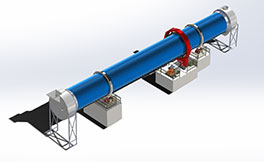
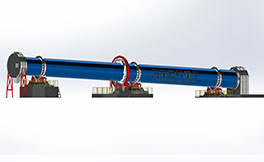
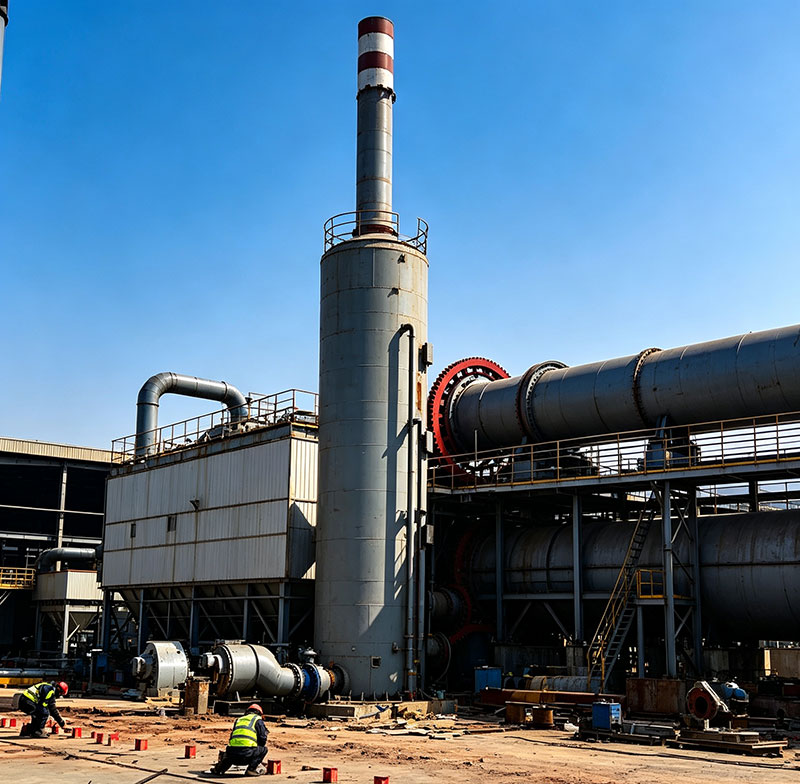
Henan Hongke Heavy Machinery Co., Ltd. is pleased to announce the successful ignition of a Φ3×60m rotary kiln for calcining phosphorus-laden sludge at a customer site in Shandong Province, China. This milestone marks the official commissioning of a brand-new production line—not a refurbishment or an upgrade of old equipment—designed specifically for the thermal treatment of phosphorus-rich sludge with resource recovery in mind.
Project Background: Turning Phosphorus-Laden Sludge into Value
Our customer in Shandong operates in the industrial and municipal wastewater treatment sector, generating significant volumes of phosphorus-laden sludge. Phosphorus (P) is an essential element for all living organisms and cannot be replaced, yet phosphate rock—the primary source for fertilizers—is a non-renewable resource facing future scarcity . Municipal and industrial sewage sludge is a carrier of phosphorus, but it also contains organic pollutants and heavy metals that complicate direct land application .
The customer's existing disposal methods—landfilling and simple incineration—were becoming increasingly costly and environmentally unsustainable. They wanted to:
Recover phosphorus from the sludge for potential fertilizer production
Destroy organic contaminants completely through high-temperature calcination
Reduce sludge volume significantly to lower disposal costs
Meet strict environmental standards for emissions and waste treatment
Produce a stable, saleable byproduct (phosphorus-enriched ash)
The customer made it clear from the start: they wanted a brand-new, purpose-built rotary kiln system specifically designed for phosphorus-laden sludge calcination—not a repurposed cement kiln or a refurbished unit.
The Challenge: Processing Phosphorus-Rich Sludge
Phosphorus-laden sludge presents several unique challenges for thermal treatment:
| Challenge | Impact |
|---|---|
| High moisture content | Requires substantial thermal energy for drying before calcination |
| Heavy metal content | Must be managed to meet fertilizer quality standards |
| Phosphorus bioavailability | Untreated ash has low bioavailability—disadvantage for agricultural use |
| Variable composition | Requires flexible process control |
| Emission control | Must capture volatile heavy metal chlorides and particulates |
Research has shown that thermochemical treatment at 800–1000°C with chlorine donors enables heavy metals to be removed via the gas phase, while phosphorus is transformed into bioavailable mineral phases such as chlorapatite, farringtonite, and stanfieldite . This two-step thermal approach—incineration followed by thermochemical conditioning—provides a pathway to safe phosphorus recovery from sewage sludge .
Our Solution: Φ3×60m Rotary Kiln System
Henan Hongke Heavy Machinery engineered and manufactured a complete brand-new calcination line centered around a Φ3×60m rotary kiln—a configuration well-suited for phosphorus-laden sludge processing at medium-to-large capacity.
Key Equipment Specifications
| Parameter | Value |
|---|---|
| Kiln diameter | 3.0 meters |
| Kiln length | 60 meters |
| Processing capacity | Custom-engineered to customer requirements |
| Operating temperature | 850–1,200°C (adjustable, with controlled zones) |
| Kiln inclination | 3.5–4% |
| Rotation speed | Variable frequency drive |
| Drive system | Heavy-duty gear drive with auxiliary motor |
| Sealing system | Advanced labyrinth seals with air purge at both ends |
Complete System Configuration
1. Feed and Pre-Drying System
The system includes a variable-speed feeder designed to handle semi-dried sludge consistently, with an integrated pre-drying section that reduces moisture content before material enters the kiln—critical for maintaining stable calcination conditions.
2. Φ3×60m Rotary Kiln
The core calcination unit features a high-quality carbon steel shell with specialized high-alumina refractory lining. The 60-meter length provides sufficient residence time for complete thermal decomposition of organic matter at 850–1,200°C. The temperature profile is precisely controlled across heating zones to achieve two key objectives: destruction of organic contaminants and transformation of phosphorus into bioavailable mineral phases. The rotating design ensures uniform heat distribution across the material.
3. Burner System
The multi-fuel burner can operate on natural gas or pulverized coal, maintaining stable temperature control across the required operating range.
4. Secondary Combustion Chamber
A secondary combustion chamber ensures complete destruction of volatile organic compounds and dioxins, with residence time at high temperature (typically 950°C and above) to achieve thorough gas cleanup.
5. Off-Gas Treatment and Heavy Metal Removal
The system incorporates a multi-stage off-gas treatment train—cyclone pre-separator followed by bag filter—with provisions for chlorine donor addition to facilitate heavy metal chloride volatilization and removal from the ash product .
6. Product Cooling and Handling
After calcination, the phosphorus-enriched ash product is cooled through a controlled cooling system before discharge, preserving the newly formed mineral phases and preventing re-absorption of moisture.
7. Automation & Control
PLC-based centralized control monitors temperature profiles, feed rates, kiln rotation speed, gas flow, and emissions in real time. Full data logging supports process optimization and quality documentation.
Why This Kiln Works for Phosphorus-Laden Sludge
Rotary kilns are the preferred technology for sludge calcination with phosphorus recovery due to their:
| Feature | Benefit |
|---|---|
| High-temperature capability | Destroys organic pollutants completely |
| Controlled temperature zones | Enables phosphorus phase transformation for bioavailability |
| Continuous operation | 24/7 processing with consistent output |
| Flexible atmosphere control | Supports addition of chlorine donors for heavy metal removal |
| Proven in sludge applications | Extensively used for sludge incineration and calcination worldwide |
Research has demonstrated that phosphorus bioavailability in sewage sludge ash can be significantly increased through thermochemical treatment in rotary furnaces, with new mineral phases such as chlorapatite and stanfieldite formed during the process .
Customer Benefits
Once fully operational, this calcination system will deliver:
| Benefit | Impact |
|---|---|
| Phosphorus recovery | P-enriched ash suitable for fertilizer production |
| Organic pollutant destruction | Complete elimination of contaminants |
| Significant volume reduction | Sludge volume reduced by 70–90% |
| Heavy metal management | Volatile metals captured and removed |
| Environmental compliance | Emissions controlled to meet standards |
| Brand-new reliability | Modern equipment with full warranty |
About Henan Hongke Heavy Machinery Co., Ltd.
Henan Hongke Heavy Machinery Co., Ltd. (Henan Hongke Machinery) has been manufacturing industrial processing equipment since 2006. Our product portfolio includes:
Rotary Kilns – for sludge calcination, lime, dolomite, metallurgy, and mineral processing
Rotary Dryers – for sludge, biomass, and industrial materials
Ball Mills – for ore, slag, cement, and chemical grinding
Crushers – for primary and secondary size reduction
We provide custom engineering, full manufacturing, installation guidance, commissioning support, and after-sales service for customers worldwide.
Summary
The successful ignition of the Φ3×60m phosphorus-laden sludge calcination kiln in Shandong marks a significant milestone for our customer's sustainable waste management strategy. This brand-new, purpose-built system transforms challenging phosphorus-rich sludge into valuable recovered materials while meeting environmental standards.
For phosphorus-laden sludge calcination, mineral processing, or other thermal treatment applications, contact Henan Hongke Heavy Machinery Co., Ltd.
Henan Hongke Heavy Machinery Co., Ltd.
Rotary Kilns | Rotary Dryers | Ball Mills | Crushers – Built New, Built Right