
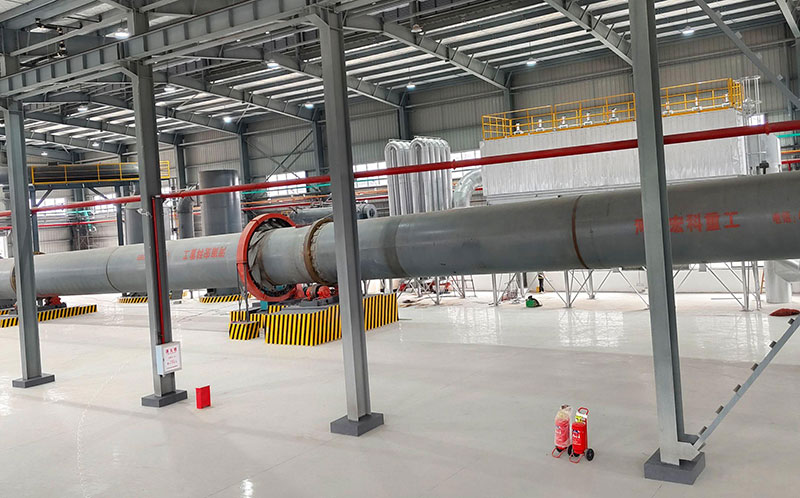
Henan Hongke Heavy Machinery Co., Ltd. is pleased to announce the successful trial run of a Φ2.5×55m catalyst rotary kiln production line at a customer site in Hubei Province, China. This milestone marks the official commissioning of a brand-new system—not a refurbishment or upgrade of old equipment—designed specifically for high-precision catalyst calcination.
Project Background: Meeting Catalyst Industry Demands
Catalysts are essential materials widely used in the petrochemical, fine chemical, and environmental protection industries. Their performance—including specific surface area, pore structure, mechanical strength, and active phase distribution—is determined during the calcination stage, a critical thermal treatment step in the preparation process .
Our customer in Hubei operates in the chemical sector, specializing in catalyst production for industrial applications. They identified the need to expand their production capacity with a modern, high-precision calcination system that could deliver consistent product quality and meet strict process control requirements.
The customer's requirements were clear:
Consistent product quality – uniform activity, specific surface area, and pore structure
Precise temperature control – essential for achieving the desired crystal phase and catalyst properties
Controlled atmosphere capability – inert gas environment required for certain catalyst grades
Continuous, reliable operation – 24/7 production with minimal downtime
Brand-new equipment – no refurbished or repurposed units
The Technology: Why Catalyst Calcination Requires a Specialized Kiln
Catalyst calcination serves multiple critical purposes: removing impurities and chemically bound water, stabilizing pore structure, controlling surface area, and finalizing the crystallization phase . Because catalysts are sensitive to contamination, calcination is always carried out in an indirect-fired rotary kiln—also known as a calciner—where the catalyst is kept separate from the heating medium, allowing an inert atmosphere to be maintained .
Unlike direct-fired kilns where combustion gases contact the material, an indirect-fired kiln heats the shell externally in controlled temperature zones. This enables precise temperature control along the length of the kiln—typically within ±5°C—and ensures the catalyst is not contaminated by combustion byproducts .
Our Solution: Φ2.5×55m Indirect-Fired Rotary Kiln
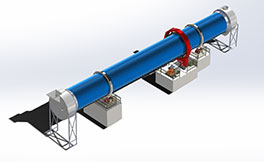
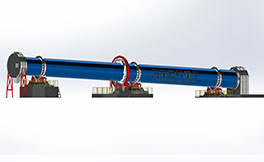
Henan Hongke Heavy Machinery engineered and manufactured a complete, brand-new catalyst calcination system centered around a Φ2.5×55m indirect-fired rotary kiln—a configuration well-suited for commercial-scale catalyst production.
Key Equipment Specifications
| Parameter | Specification |
|---|---|
| Kiln diameter | 2.5 meters |
| Kiln length | 55 meters |
| Heating method | Indirect external heating (electric or gas-fired furnace shroud) |
| Operating temperature | 400–1,000°C (adjustable by zone) |
| Temperature control accuracy | ≤ ±5°C |
| Kiln slope | 3–4% |
| Rotation speed | Variable frequency drive |
| Sealing system | Advanced seals for atmosphere integrity |
System Configuration
1. Feed System
Variable-speed screw feeder ensuring consistent material entry—critical for maintaining uniform residence time and product quality.
2. Φ2.5×55m Indirect-Fired Rotary Kiln
The core calcination unit features a heat-resistant alloy cylinder enclosed in a multi-zone furnace shroud. The heating medium (electric elements or gas burners) heats the shell externally, transferring thermal energy to the catalyst through contact with the hot shell wall . The 55-meter length provides sufficient residence time for complete thermal treatment. The rotating action ensures uniform material tumbling and prevents localized overheating .
3. Multi-Zone Temperature Control System
Independent temperature control across heating zones—each with separate heating elements and thermocouples—allows precise profile management tailored to the specific calcination requirements. Temperature control accuracy of ≤ ±5°C ensures consistent product properties batch after batch .
4. Atmosphere Control System
The kiln is equipped with sealing systems at both feed and discharge ends, allowing an inert atmosphere (nitrogen, argon, or controlled gas mix) to be maintained throughout the calcination process—essential for catalyst grades that require non-oxidizing conditions .
5. Product Cooling System
After calcination, the product passes through a cooling section before discharge, enabling direct packaging and preventing moisture re-absorption.
6. Exhaust Gas Treatment
Multi-stage dust collection captures fine particulates from the exhaust stream before atmospheric release.
7. Automation & Control
PLC-based centralized control monitors temperature profiles across all zones, feed rate, kiln rotation speed, and atmosphere conditions in real time. Full data logging supports quality certification and process optimization.
Key Design Features for Catalyst Calcination
| Feature | Benefit |
|---|---|
| Indirect heating design | Prevents catalyst contamination; allows inert atmosphere |
| Multi-zone temperature control | Precise profile management; ±5°C accuracy |
| External heating furnace | Uniform heat distribution along the shell; reduced thermal stress |
| Advanced sealing system | Maintains atmosphere integrity; minimizes gas leakage |
| Controlled atmosphere capability | Supports air, nitrogen, or reducing conditions |
| Variable speed drive | Residence time adjustment to match product specifications |
Successful Trial Run Results
The trial run confirmed that the system meets all design specifications:
Temperature stability – All zones achieve and maintain setpoint temperatures within ±5°C
Atmosphere integrity – Inert gas environment maintained throughout operation
Product quality – Initial test batches show consistent surface area and pore structure meeting customer specifications
Continuous operation – System runs smoothly with automated monitoring and minimal operator intervention
Customer Benefits
This calcination system delivers:
| Benefit | Impact |
|---|---|
| Consistent catalyst quality | Uniform activity, surface area, and mechanical strength |
| Precise process control | Multi-zone temperature profile management |
| Inert atmosphere capability | Supports sensitive catalyst materials |
| Continuous production | 24/7 operation, no batch-to-batch variability |
| Contamination-free processing | Indirect heating ensures product purity |
| Full data logging | Quality documentation for certification |
About Henan Hongke Heavy Machinery Co., Ltd.
Henan Hongke Heavy Machinery Co., Ltd. (Henan Hongke Machinery) has been manufacturing industrial processing equipment since 2006. Our product portfolio includes:
Rotary Kilns – for catalysts, lime, dolomite, zinc oxide, and mineral calcination
Rotary Dryers – for sludge, biomass, and industrial materials
Ball Mills – for ore, slag, cement, and chemical grinding
Crushers – for primary and secondary size reduction
We provide custom engineering, full manufacturing, installation guidance, commissioning support, and after-sales service for customers worldwide.
Summary
The successful trial run of the Φ2.5×55m catalyst rotary kiln production line in Hubei demonstrates Henan Hongke Heavy Machinery's ability to deliver specialized calcination equipment for the chemical catalyst industry. By integrating indirect heating design, multi-zone temperature control, inert atmosphere capability, and automated monitoring, the system produces consistent, high-quality catalyst material with optimized process efficiency.
For catalyst calcination, mineral processing, or other thermal treatment applications, contact Henan Hongke Heavy Machinery Co., Ltd.
Henan Hongke Heavy Machinery Co., Ltd.
Rotary Kilns | Rotary Dryers | Ball Mills | Crushers – Engineered for Real-World Results