
Coal gangue is one of the largest industrial solid waste streams in China. Accumulated in massive stockpiles near mining sites, it poses severe environmental risks including groundwater contamination, spontaneous combustion, and land occupation. For decades, the prevailing approach was simple disposal — dump it and walk away.
Henan Hongke Heavy Machinery Co., Ltd. is changing that equation. By engineering purpose-built rotary kiln systems that transform coal gangue into high-value calcined kaolin, Henan Hongke Machinery enables mining and mineral-processing operators to turn a costly liability into a profitable product.
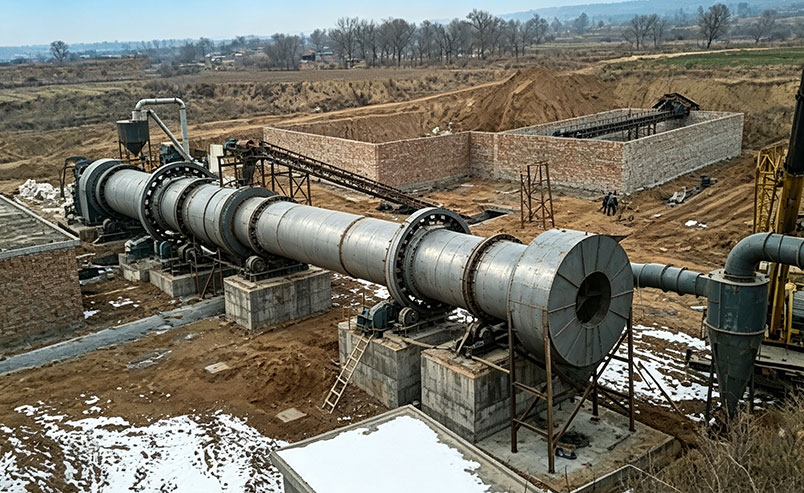
The 300 TPD coal gangue rotary kiln production line in Jingyang, Shaanxi Province, is a flagship example of this approach. This article walks through the project background, process design, key equipment, and the technical advantages that make coal gangue calcination a commercially and environmentally compelling solution.
Project Background
The Challenge: Mountains of Coal Gangue
Jingyang County, located in the central part of Shaanxi Province, sits within a region historically active in coal mining. Over years of extraction, enormous quantities of coal gangue — a low-carbon, hard, rock-like byproduct of coal washing — had been stockpiled across the landscape. Left untreated, these gangue dumps release sulfur dioxide and other pollutants, acidify surrounding soils, and consume valuable agricultural land.
The project owner recognized that coal gangue, despite being classified as waste, contains a high proportion of kaolinite (Al₂Si₂O₅(OH)₄). When subjected to controlled high-temperature calcination, kaolinite undergoes dehydroxylation and phase transformation, yielding metakaolin or fully calcined kaolin — a white, high-brightness mineral with extensive applications in paper coating, paint, rubber, ceramics, and refractory materials.
The vision was clear: build a large-scale production line that processes 300 tonnes of raw coal gangue per day, producing white calcined kaolin that meets industrial-grade specifications.
Why Henan Hongke Machinery Was Selected
Henan Hongke Heavy Machinery Co., Ltd. has designed and manufactured rotary kiln systems for over two decades, with installations spanning cement, lime, bauxite, magnesite, and — critically — solid waste processing applications. The client selected Henan Hongke Machinery based on the company's proven track record in engineering coal gangue calcination systems, its in-house manufacturing capability for large-diameter rotary kilns, and its ability to provide turnkey project support from process design through commissioning.
Process Flow: From Raw Coal Gangue to White Calcined Kaolin
The production line follows a tightly integrated, multi-stage process. Each stage is engineered to ensure that the final calcined kaolin product achieves the required whiteness, particle size distribution, and chemical purity.
Stage 1 — Raw Material Preparation and Crushing
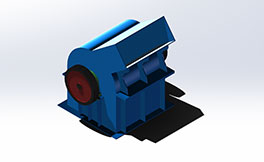
Raw coal gangue arrives at the plant receiving area, where it is inspected for composition and moisture content. Oversized blocks are reduced through a jaw crusher to a feed size suitable for the grinding circuit. A belt conveyor system transfers the crushed gangue to a covered storage yard to manage moisture and prevent cross-contamination.
Stage 2 — Grinding (Pulverization)
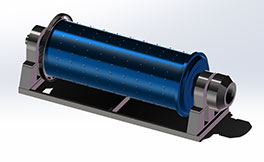
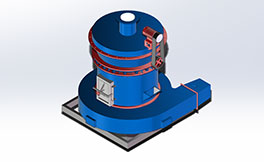
The crushed coal gangue enters a ball mill or vertical roller mill, where it is ground to a fine powder — typically achieving a particle size of 200 mesh (75 µm) or finer. Fine grinding is essential because it maximizes the surface area of the kaolinite particles, ensuring uniform heat penetration during calcination and consistent dehydroxylation throughout the material.
Henan Hongke Machinery configures the grinding circuit with a high-efficiency powder separator to control particle size distribution and minimize over-grinding, which saves energy and protects downstream equipment.
Stage 3 — Pulping (Slurry Preparation)
The ground coal gangue powder is mixed with water in a pulping tank to form a uniform slurry. Pulping serves multiple purposes:
- Homogenization — Ensures consistent chemical and mineral composition across the entire batch before classification.
- Transport — The slurry form allows easy pumping through the classification system.
- Impurity Separation — Wet processing enables the removal of iron-bearing minerals, carbon residues, and other impurities that would otherwise discolor the final product.
The slurry concentration is precisely controlled to optimize classification efficiency.
Stage 4 — Classification (Grading and Purification)
The slurry passes through a hydrocyclone classification system or spiral classifier. This stage separates the feed into multiple fractions based on particle size and density:
- Coarse fraction — Returned to the grinding mill for further size reduction.
- Qualified fraction — The target particle size range, forwarded to the dewatering and drying stage.
- Ultra-fine and impurity fraction — Removed as waste or diverted to low-value applications.
Magnetic separation may also be applied at this stage to remove trace iron oxides, a critical step for achieving high whiteness in the finished calcined kaolin. The classification stage effectively upgrades the raw coal gangue concentrate to a purified kaolin feed ready for thermal processing.
Stage 5 — Dewatering and Drying
After classification, the kaolin slurry is thickened in a settling tank or thickener and then filtered using a vacuum filter or plate-and-frame filter press. The resulting filter cake has a moisture content of approximately 15–25%, which must be reduced before entering the rotary kiln.
A rotary dryer, supplied by Henan Hongke Machinery, brings the moisture content down to below 2%, producing a dry, free-flowing kaolin powder that can be evenly fed into the calcination system.
Stage 6 — High-Temperature Calcination in the Rotary Kiln
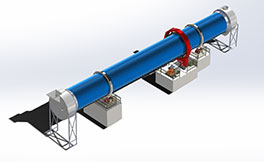
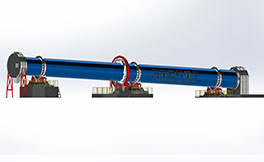
This is the heart of the entire production line. The dried kaolin feed enters the rotary kiln — a large-diameter, slowly rotating cylindrical furnace — where it is subjected to temperatures ranging from 800 °C to 1,050 °C (depending on the desired product specifications).
Inside the rotary kiln, the following critical transformations occur:
- 1.
Dehydroxylation — At approximately 500–600 °C, the hydroxyl groups (–OH) bonded within the kaolinite crystal lattice are driven off as water vapor. This converts kaolinite (Al₂Si₂O₅(OH)₄) into metakaolin (Al₂Si₂O₇), an amorphous, highly reactive aluminosilicate phase.
- 2.
Phase Transformation and Whitening — As the temperature rises further, residual carbonaceous matter (inherited from the coal gangue) is completely burned out. Iron-bearing impurities are oxidized and stabilized. The result is a dramatic color shift — from the dark grey or black of raw coal gangue to a bright white calcined product.
- 3.
Crystal Structure Rearrangement — The original layered crystal structure of kaolinite is destroyed and replaced by an amorphous or spinel-type structure, depending on peak temperature and residence time. This structural change imparts improved brightness, lower oil absorption, and enhanced whiteness — properties highly valued in downstream industries.
The rotary kiln's design is critical to product quality. Henan Hongke Machinery engineers the kiln with precise control over:
- Rotational speed — Governing material residence time and heat exposure.
- Inclination angle — Controlling material flow rate through the kiln.
- Temperature profile — Multi-zone heating ensures gradual temperature rise, preventing thermal shock and cracking of kaolin particles.
- Atmosphere control — Maintaining an oxidizing atmosphere to burn out residual carbon and achieve maximum whiteness.
The kiln shell is constructed from high-grade steel with refractory lining rated for continuous high-temperature operation. A multi-channel burner system provides precise fuel control, and a heat recovery system preheats the incoming feed using exhaust gas energy, improving overall thermal efficiency.
Stage 7 — Cooling and Product Handling
As the white calcined kaolin exits the rotary kiln at elevated temperature, it enters a rotary cooler where its temperature is reduced to below 80 °C for safe handling and packaging. The cooled product is then conveyed to storage silos, where it is sampled, tested for whiteness (typically measured on the ISO or Hunter scale), particle size, and chemical composition, and finally packaged for shipment.
Key Equipment Supplied by Henan Hongke Machinery
Project Results and Benefits
Environmental Impact
- 300 tonnes of coal gangue processed daily — diverting solid waste from landfills and dump sites.
- Complete carbon burnout during calcination eliminates the risk of spontaneous combustion associated with gangue stockpiles.
- Closed-loop water recycling in the pulping and classification stages minimizes freshwater consumption.
- Emissions compliant with national standards through integrated dust collection and flue gas treatment.
Economic Value
- The finished product — white calcined kaolin — commands a significant market price in the paper, paint, plastics, and ceramics industries, far exceeding the zero-value or negative-value status of raw coal gangue.
- The project creates a new revenue stream from what was previously a disposal cost.
- High thermal efficiency of the rotary kiln system reduces per-tonne fuel consumption, improving profit margins.
Technical Performance
- Product whiteness: ≥ 90% (ISO brightness)
- Product fineness: -2 µm content ≥ 85% (after optional post-grinding)
- Kiln availability: > 92% annual operating rate
- Fully automated operation with remote monitoring capability
Why Choose Henan Hongke Machinery for Coal Gangue Calcination Projects
Henan Hongke Heavy Machinery Co., Ltd. brings together process engineering expertise, in-house rotary kiln manufacturing, and decades of project execution experience. For coal gangue calcination specifically, the company offers:
- Customized process design — Every coal gangue source is different. Henan Hongke Machinery analyzes the raw material chemistry, mineralogy, and moisture characteristics before engineering the optimal production flow.
- Turnkey project delivery — From feasibility study and equipment manufacturing to installation supervision, commissioning, and operator training.
- Proven rotary kiln technology — Robust, reliable kiln designs refined through hundreds of industrial installations.
- After-sales support — Spare parts supply, technical consultation, and performance optimization services throughout the project lifecycle.
Conclusion
The 300 TPD coal gangue rotary kiln production line in Jingyang, Shaanxi, demonstrates that solid waste recycling is not only an environmental imperative but also a sound business strategy. By converting coal gangue into white calcined kaolin through a carefully engineered process of grinding, pulping, classification, and high-temperature rotary kiln calcination, this project achieves what was once thought impractical — turning mountains of waste into a valuable industrial mineral.
Henan Hongke Heavy Machinery Co., Ltd. is proud to have supplied the core equipment and engineering expertise behind this transformation. If you are exploring coal gangue utilization, solid waste recycling, or calcined kaolin production, our team is ready to discuss how we can support your project.
Contact Henan Hongke Machinery today to learn more about our coal gangue rotary kiln solutions.