
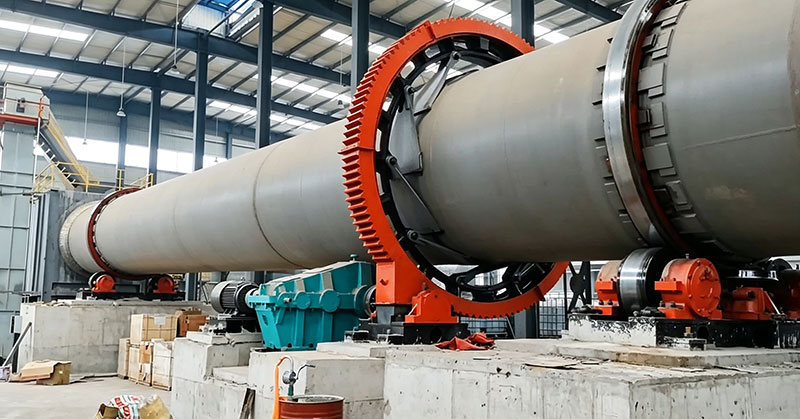
Henan Hongke Heavy Machinery Co., Ltd. is pleased to report on the successful deployment of a Φ2.2×45m catalyst rotary kiln at a customer site in Hubei Province, China. This project demonstrates our capability to deliver specialized calcination equipment for the chemical catalyst manufacturing industry.
Project Background: Catalyst Calcination Demands Precision
Our customer in Hubei is a chemical manufacturer specializing in catalyst production for the petrochemical and environmental sectors. Catalyst manufacturing involves multiple process steps, including precipitation, drying, forming, and critically—calcination. During calcination, catalyst precursors undergo thermal treatment to develop the desired physical and chemical properties: specific surface area, pore structure, mechanical strength, and active phase distribution .
The customer's existing calcination equipment—a batch-type furnace—could not meet their growing production requirements. Key limitations included:
Inconsistent product quality – Batch-to-batch variation in catalyst activity
Low throughput – Bottleneck in the overall production line
High energy consumption – Poor thermal efficiency in older equipment
Limited temperature control precision – Critical for catalyst performance
The customer required a continuous, high-capacity calcination solution with precise temperature control and uniform heating to produce consistent catalyst quality at scale.
The Challenge: Uniform Heating and Process Control
Catalyst calcination presents several specific engineering challenges:
| Challenge | Impact |
|---|---|
| Temperature uniformity | Uneven heating causes differential phase development, affecting catalyst performance |
| Controlled atmosphere | Some catalysts require specific gas conditions during calcination |
| Residence time control | Critical for achieving target surface area and pore structure |
| Product purity | Contamination from kiln components must be minimized |
The customer's target product included alumina-based catalyst supports—materials that require calcination at temperatures of approximately 400–650°C to develop the desired specific surface area and mechanical properties . The calcination process must be carefully controlled to avoid over-calcination, which can reduce surface area and catalytic activity.
Our Solution: Φ2.2×45m Catalyst Rotary Kiln
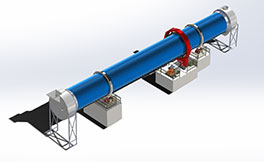
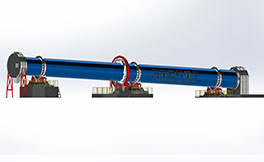
Henan Hongke Heavy Machinery engineered a complete calcination system centered around a Φ2.2×45m rotary kiln—a configuration well-suited for continuous catalyst production at moderate throughput rates.
Key Equipment Specifications
| Parameter | Value |
|---|---|
| Kiln diameter | 2.2 meters |
| Kiln length | 45 meters |
| Operating temperature range | 300–650°C (adjustable) |
| Temperature control accuracy | ±5°C |
| Kiln inclination | 3.5–4% |
| Rotation speed | Variable frequency drive (0.5–3.5 rpm) |
| Drive system | Heavy-duty gear drive with auxiliary motor |
| Sealing system | Labyrinth seals with air purge at both ends |
| Refractory lining | High-alumina, selected for chemical resistance |
| Shell material | Q235-B carbon steel with appropriate thickness |
Complete System Configuration
1. Feed System
The system includes a screw feeder with variable-speed control to ensure consistent material feed rate—critical for maintaining uniform residence time and product quality.
2. Φ2.2×45m Rotary Kiln
The core calcination unit features a high-quality carbon steel shell with high-alumina refractory lining. The 45-meter length provides sufficient residence time for complete thermal treatment at 400–650°C, ensuring the development of target surface area (typically 5–30 m²/g for alumina-based catalysts) . The kiln is equipped with a precision temperature control system that maintains uniform temperature profiles across the heating zones.
3. Atmosphere Control System
The kiln includes provisions for controlled atmosphere operation. For certain catalyst grades, an inert or reducing gas atmosphere is required during calcination to achieve the desired reduction state of active components . The seal system is designed to minimize gas leakage and maintain atmospheric integrity.
4. Dust Collection System
A multi-stage dust collection system—cyclone pre-separator followed by bag filter—captures fine particles and ensures emissions compliance. Material loss during calcination is minimized, improving product yield.
5. Automation & Control
PLC-based centralized control monitors temperature profiles, feed rate, kiln rotation speed, and emissions in real time. A data logging system tracks all process parameters for quality documentation and process optimization.
6. Product Cooling System
After calcination, product is discharged through a cooling system that brings material temperature below 100°C before packaging, preventing moisture re-absorption and ensuring safe handling.
Why Rotary Kiln for Catalyst Calcination?
Rotary kilns offer several advantages for catalyst calcination compared to batch furnaces or other continuous alternatives:
| Advantage | Explanation |
|---|---|
| Continuous operation | 24/7 production, eliminating batch-to-batch variability |
| Precise residence time control | Product quality consistency through controlled exposure duration |
| Gas atmosphere management | Ability to maintain inert, oxidizing, or reducing conditions as required |
| Scalability | Easy to scale from pilot to commercial production |
| Material handling | Gentle tumbling action reduces attrition of formed catalyst particles |
Research has demonstrated that rotary kiln calcination can be successfully scaled from laboratory batch processing to commercial continuous production by matching temperature profiles and residence times between scales .
Customer Benefits
Once fully operational, this calcination system will deliver:
| Benefit | Impact |
|---|---|
| Consistent catalyst quality | Uniform activity, surface area, and mechanical strength |
| Continuous production | Eliminates batch changeover losses and variability |
| High throughput | Meets growing market demand |
| Energy efficiency | Continuous operation with heat recovery potential |
| Process documentation | Full data logging for quality certification |
About Henan Hongke Heavy Machinery Co., Ltd.
Henan Hongke Heavy Machinery Co., Ltd. (Henan Hongke Machinery) has been manufacturing industrial processing equipment since 2006. Our product portfolio includes:
Rotary Kilns – for catalyst, lime, dolomite, metallurgy, and mineral calcination
Rotary Dryers – for sludge, biomass, and industrial materials
Ball Mills – for ore, slag, cement, and chemical grinding
Crushers – for primary and secondary size reduction
We provide custom engineering, full manufacturing, installation guidance, and after-sales support for customers worldwide .
Summary
The Φ2.2×45m catalyst rotary kiln project in Hubei demonstrates Henan Hongke Machinery's ability to deliver specialized calcination solutions for the chemical catalyst industry. By integrating precise temperature control, continuous operation, and automated monitoring, the system will produce consistent, high-quality catalyst material with optimized process efficiency.
For catalyst calcination, mineral processing, or other thermal treatment applications, contact Henan Hongke Heavy Machinery Co., Ltd.
Henan Hongke Heavy Machinery Co., Ltd.
Rotary Kilns | Rotary Dryers | Ball Mills | Crushers – Engineered for Real-World Results