
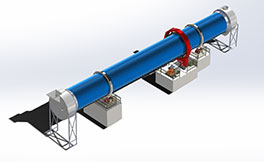
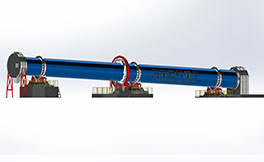
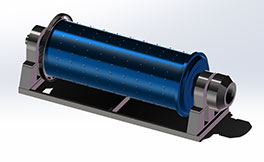
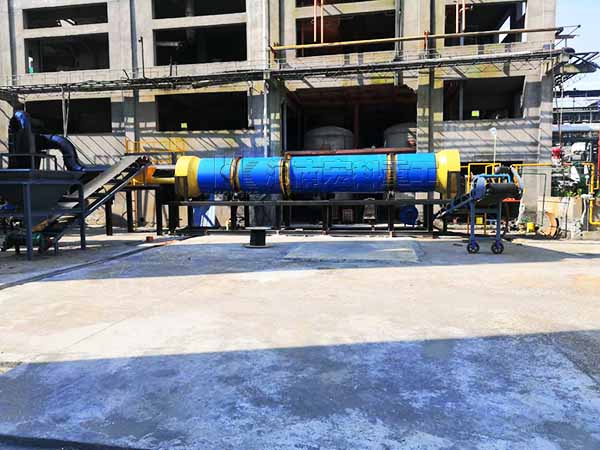
Henan Hongke Heavy Machinery Co., Ltd. ("Henan Hongke Machinery") has recently completed the manufacturing of a φ1.2 × 10 m rotary dryer for a chemical sludge treatment project located in Hubei Province, China. The equipment is currently in the final stages of production at Henan Hongke Machinery's manufacturing facility and is being prepared for shipment to the client's site.
This project addresses a growing industrial challenge: the safe, efficient, and environmentally responsible disposal of chemical sludge — a hazardous waste stream generated by the chemical, pharmaceutical, petrochemical, and electroplating industries.
The Challenge: Chemical Sludge Disposal
Chemical sludge is one of the most difficult industrial waste materials to handle. It is typically:
- High in moisture content (65–85% water as generated), making it heavy, viscous, and expensive to transport
- Chemically complex, containing variable combinations of heavy metals, organic compounds, residual chemicals, and fine particulate matter
- Subject to strict environmental regulations in most jurisdictions — improper handling or disposal can result in severe penalties and environmental damage
For the Hubei client, the challenge was clear: they needed a reliable, continuous drying system that could reduce the moisture content of their chemical sludge from approximately 80% down to 20–30%, transforming it from a wet, unmanageable waste into a dry, stable material suitable for:
- Incineration in a dedicated hazardous waste incinerator
- Solidification and stabilization prior to landfill disposal
- Further processing for resource recovery where applicable
The drying process is critical because it reduces sludge volume by 60–75%, dramatically cutting transportation costs and enabling downstream treatment options that are not feasible with wet sludge.
Equipment Specification
The rotary dryer supplied by Henan Hongke Machinery for this project has the following key specifications:
Design Features for Chemical Sludge Application
Chemical sludge is not ordinary municipal sludge. Its aggressive chemical composition, variable consistency, and regulatory sensitivity require specific design adaptations that standard agricultural or mineral dryers do not provide. The Henan Hongke Machinery engineering team incorporated the following features specifically for this application:
Corrosion-Resistant Internal Materials
The dryer shell interior is fitted with SS304 stainless steel lining in the feed and high-moisture zones where the sludge is most chemically aggressive. This extends equipment life significantly compared to a fully carbon-steel shell when processing chemically corrosive sludge.
Indirect Heating Design
For chemical sludge containing volatile organic compounds (VOCs) or other hazardous components, the dryer uses an indirect heating configuration. The hot combustion gases flow through a jacket or inner tube surrounding the drying chamber, transferring heat through the shell wall without direct contact between the flue gas and the sludge. This approach offers two critical advantages:
- 1.Reduced exhaust gas volume — only the moisture evaporated from the sludge plus a small amount of sweep air needs to be treated, minimizing the size and cost of the downstream exhaust gas treatment system.
- 2.Lower risk of secondary pollution — no combustion byproducts (ash, unburned fuel, CO) mix with the sludge off-gas, simplifying compliance with emission regulations.
Internal Lifting Flights
The interior of the rotating shell is fitted with specially designed lifting flights (flights/louvers) that pick up the sludge as the drum rotates and cascade it through the hot gas stream in a thin, uniform curtain. This maximizes the contact surface area between the sludge and the drying medium, ensuring efficient heat transfer and uniform drying. The flight geometry is optimized for the sticky, cohesive nature of chemical sludge — preventing material buildup and ensuring consistent tumbling.
Sealed Feed and Discharge Ends
Both the feed and discharge ends of the dryer are fitted with ** labyrinth-type sealing systems** to minimize air leakage, prevent fugitive emissions of odors or hazardous vapors, and maintain proper negative pressure inside the drum. The discharge end is connected to a sealed collection system that conveys the dried sludge to storage or directly to the next processing stage.
Integrated Exhaust Gas Treatment
The moisture-laden exhaust gas exiting the dryer is routed through a condensation and scrubbing system before discharge. This system:
- Condenses water vapor and recovers liquid condensate for treatment
- Scrubs residual odors and trace contaminants using an alkaline or oxidizing scrubber solution
- Reduces the exhaust gas temperature and dew point before final discharge through a stack
The client's system includes a spray tower scrubber with recirculated caustic solution, achieving odor and trace contaminant removal sufficient to meet local environmental discharge standards.
Working Principle
The chemical sludge drying process in the rotary dryer follows a straightforward but carefully controlled sequence:
Step 1: Feeding
Wet chemical sludge (typically at 75–85% moisture) is fed into the elevated end of the inclined rotary drum by a screw feeder or belt conveyor with controlled speed, ensuring a steady, uniform feed rate matched to the dryer's thermal capacity.
Step 2: Drying
As the drum rotates at 3–8 rpm, the internal lifting flights continuously lift the sludge and cascade it through the hot air zone inside the drum. In the indirect heating configuration, heat transfers from the hot shell wall and the hot air stream into the sludge particles, evaporating moisture. The sludge progresses through three zones:
- 1.Preheat zone (feed end): The sludge temperature rises rapidly; surface moisture begins to evaporate.
- 2.Constant-rate drying zone (middle section): The bulk of the free moisture is removed. The sludge temperature remains relatively stable at the wet-bulb temperature of the drying air.
- 3.Falling-rate zone (discharge end): Remaining bound moisture is driven off; the sludge temperature rises as it approaches the target moisture content.
Step 3: Discharge
Dried sludge exits from the lower end of the drum at 20–30% moisture content. It is collected by a sealed conveyor and transported to storage, incineration, or further processing.
Step 4: Exhaust Gas Treatment
The moisture-laden exhaust gas exits the dryer through a duct at the feed end, passes through the condensation/scrubbing system, and is discharged through the stack at controlled temperature and emission levels.
Key Performance Advantages
Why a Rotary Dryer for Chemical Sludge?
Several drying technologies are available for industrial sludge — belt dryers, paddle dryers, fluidized bed dryers, and thin-film dryers among them. The rotary dryer remains a preferred choice for many chemical sludge applications for the following reasons:
- Tolerance for variable feed: Chemical sludge composition and moisture content can fluctuate significantly. The rotary dryer's large thermal mass and long residence time (20–40 minutes) accommodate these variations without upset.
- Handling of sticky materials: Unlike fluidized bed dryers, which struggle with cohesive, sticky sludge, the rotary dryer's mechanical tumbling action and flight design break up lumps and prevent caking.
- Scalability: Rotary dryers are available from small (φ0.8 m) to very large (φ3.6 m+) diameters, making them suitable for a wide range of processing capacities.
- Proven reliability: The rotary dryer is the most widely used industrial drying technology worldwide, with decades of operating experience across hundreds of sludge drying applications.
- Lower capital cost: For mid-range capacities (1–10 t/h), the rotary dryer typically offers a lower installed cost per ton of dried product compared to more complex alternatives.
Project Execution
Henan Hongke Machinery managed this project from engineering through manufacturing under a single contract:
Engineering (4 weeks):
- Process design and thermal calculation based on the client's sludge characterization data
- Mechanical design including shell thickness calculation, drive sizing, and structural support design
- Exhaust gas treatment system design
- General arrangement and foundation load drawings for the client's civil contractor
Manufacturing (8 weeks):
- Shell plate rolling, welding, and post-weld heat treatment in Henan Hongke Machinery's workshop
- Internal flight fabrication and installation
- SS304 liner fabrication and fitting
- Girth gear and drive system assembly
- Feed and discharge end fabrication with sealing systems
- Pre-assembly and dimensional verification before shipping
Shipping and Installation Support:
- Equipment disassembled into transportable modules and shipped to Hubei
- Henan Hongke Machinery's installation supervisor deployed to the client's site to guide erection, alignment, and connection
- Cold commissioning (mechanical and electrical checks) and hot commissioning (first fire, feed introduction, and performance testing)
Client Feedback
The client's engineering manager commented during the final inspection at Henan Hongke Machinery's workshop:
"We visited several dryer manufacturers before selecting Henan Hongke Machinery. The quality of fabrication we saw in their workshop — the welding, the fit-up, the attention to detail on the stainless steel lining — gave us confidence that this equipment will perform reliably in our chemical sludge application. The technical team was very responsive throughout the engineering phase, and the project has been managed professionally from start to finish."
About Henan Hongke Heavy Machinery Co., Ltd.
Henan Hongke Heavy Machinery Co., Ltd., based in Henan Province, China, is a professional manufacturer of industrial rotary equipment including rotary dryers, rotary kilns, and rotary coolers for applications across the chemical, environmental, metallurgical, mining, and building materials industries.
With a comprehensive manufacturing facility equipped with plate rolling machines, CNC machining centers, welding stations, and quality control laboratories, Henan Hongke Machinery delivers engineered solutions from process design through manufacturing, installation supervision, and after-sales support.